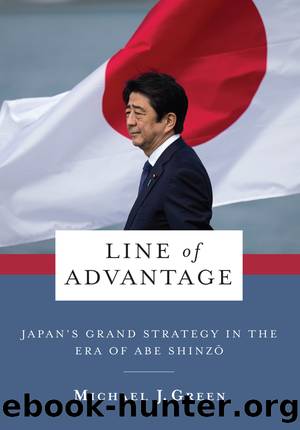
Line of Advantage by Michael J. Green
Author:Michael J. Green
Language: eng
Format: epub
Tags: POL054000, Political Science/World/Asian, POL011010, Political Science/International Relations/Diplomacy
Publisher: Columbia University Press
Published: 2022-03-22T00:00:00+00:00
The U.S. Factor
Genron NPO surveys in Japan and Korea in 2019 indicated that large majorities of Japanese and Koreans could agree on one thingâthat relations were bad.65 As to why they were bad, Japanese by a wide margin answered, âbecause Korea continues to criticize Japan on history issues,â while Koreans answered that relations were bad because of territorial disputes and Japanâs ârefusal to address history issues.â The fact that Korea was an outlier in confronting Japan on history only reinforced Japanese impressions that Seoul was leaning toward Chinaâs vision of regional order. The Japanese government faced no pressure at home or from key allies and partners to pay reparations. In 2007 Korea had held the high ground on the comfort women issue internationally because Japan had threatened to revoke the forward-looking Kono statement. In 2020 it was Korea that stood alone diplomatically because its government was refusing to abide by the terms of an international treaty. Yet the Korean government also feared the domestic backlash if it defied the popular will by failing to implement the Supreme Court ruling. Japanese political leaders saw little advantage in taking steps to transform the political atmosphere until Korea dropped its demands. When Suga replaced Abe in September 2020, his first move vis-Ã -vis Seoul was to announce that he would not participate in a planned China-Japan-ROK summit with Moon Jae-in until the threat to seize Japanese corporate assets was removed, though he did engage in a positive meeting with South Koreaâs visiting intelligence chief in Tokyo that November.66
In previous cases the U.S. government would have quietly weighed in to help Seoul and Tokyo overcome domestic opposition to resolving disputes, as the Obama administration quietly did in the lead-up to the Abe-Park December 2015 agreement. However, President Trump undercut his own officials when he bemoaned requests that he bring Moon and Abe closer together, whining to the press in July 2019, âHow many things do I have to get involved in?â67 Behind the scenes Pentagon officials prevailed upon the Moon government not to suspend the intelligence-sharing GSOMIA agreement with Japan, which Parkâs government had brought back into effect in 2016. At higher political levels, however, Trump did little to repair relations among Americaâs two closest allies in Northeast Asia the way Bush or Obama had before him.68 Instead he continued his effusive praise of Kim Jong-un and his criticism of allies ripping off the United States until he left office. When President Joe Biden tried to improve Japan-Korea relations in his initial discussions with Suga and Moon in 2021, he could at least be confident that the divisions between Seoul and Tokyo were not about shared interests with the United States, but he had a lot of lost ground to make up.
Download
This site does not store any files on its server. We only index and link to content provided by other sites. Please contact the content providers to delete copyright contents if any and email us, we'll remove relevant links or contents immediately.
| Arms Control | Diplomacy |
| Security | Trades & Tariffs |
| Treaties | African |
| Asian | Australian & Oceanian |
| Canadian | Caribbean & Latin American |
| European | Middle Eastern |
| Russian & Former Soviet Union |
The Secret History by Donna Tartt(19090)
The Social Justice Warrior Handbook by Lisa De Pasquale(12190)
Thirteen Reasons Why by Jay Asher(8912)
This Is How You Lose Her by Junot Diaz(6887)
Weapons of Math Destruction by Cathy O'Neil(6281)
Zero to One by Peter Thiel(5802)
Beartown by Fredrik Backman(5755)
The Myth of the Strong Leader by Archie Brown(5508)
The Fire Next Time by James Baldwin(5446)
How Democracies Die by Steven Levitsky & Daniel Ziblatt(5219)
Promise Me, Dad by Joe Biden(5153)
Stone's Rules by Roger Stone(5088)
A Higher Loyalty: Truth, Lies, and Leadership by James Comey(4964)
100 Deadly Skills by Clint Emerson(4926)
Rise and Kill First by Ronen Bergman(4789)
Secrecy World by Jake Bernstein(4753)
The David Icke Guide to the Global Conspiracy (and how to end it) by David Icke(4720)
The Farm by Tom Rob Smith(4514)
The Doomsday Machine by Daniel Ellsberg(4490)
